B2B SaaS — Billing & Revenue Platform
Redesigning the
billing module
for scale
A 2-month brief to redesign OneBill's pricing module — driven by a business requirement to consolidate operations onto a single canvas, and built so the IA could absorb new pricing models without re-fragmenting.
42%
FASTER WORKFLOW
Client reported. post rollout
0
PAGE NAVIGATION
Verifiable from design
2 mo
PROJECT DURATION
The constraint
Scroll
OVERVIEW
An enterprise billing platform
that had outgrown its own
structure
A centralised billing and monetisation platform that unifies CPQ, Billing & Revenue Management, CRM, ERP, Provisioning, and Channel Partner Management into a single solution.
The pricing module sat at the centre of that breadth. As OneBill onboarded new customers with new pricing models, the existing structure couldn't absorb them cleanly. The business team came to design with a clear brief: consolidate the workflow, make administrators productive on a single page, and do it in two months.
ROLE
UX Designer
DURATION
2 Months
PLATFORM
Web App
DOMAIN
B2B Saas Billing
THE PROBLEM
Pricing Page Was Broken at scale
Administrators managing complex catalogs had to navigate across multiple disparate pages to complete what should have been a single, in-context workflow. As OneBill grew, the architecture fragmented further — making every new pricing model harder to add than the last.
USER FLOW BEFORE REDESIGN - FRAGMENTED NAVIGATION
Open Products
Navigate to Plans
New Page Load
Configure Pricing
Another Page
Add Devices
Yet Another Page
Compare Plans
Users were forced to visit multiple pages to complete a single pricing task — creating unnecessary cognitive load and dramatically slowing down product creation workflows.
CONSTRAINT & DESIGN BET
Naming the constraint shaped
everything.
Two months on a critical enterprise module is genuinely short. Rather than pretend it wasn't, I let the timeline shape the design strategy — and turned the business team's brief into an explicit, defensible design principle.
THE CONSTRAINT
2 months. Enterprise billing. Scaling pressure.
Compressed timeline ruled out a full user-research programme. The business team had a clear ask: consolidate administrator workflows now, and make the structure ready for what's next. I scoped honestly: a focused redesign of the pricing module — not the whole platform — grounded in platform audit, business requirements, and competitive benchmarking, with scaling as the explicit design agenda from day one.
THE DESIGN BET
Maximum operations per page. Built to scale.
One principle drove every decision: give the administrator the maximum number of operations on a single page, structured so new pricing models can slot in without fragmenting the IA. Not "improve the UX" — a specific, testable bet about what billing administrators need most. Consolidation as a design philosophy, not just an outcome.
GROUNDING THE DECISION
Research scoped to match the timeline.
Two months on a critical enterprise module is genuinely short. Rather than pretend it wasn't, I let the timeline shape the design strategy — and turned the business team's brief into an explicit, defensible design principle.
SCOPE, STATED PLAINLY
I did not build Capillary's AI models — the Nudge recommendations, propensity scores, and ML outputs were the data team's work, and they were good. My design problem was different and just as hard: how do you make existing machine intelligence ambient, legible, and trustworthy for a non-technical marketer, without burying it or overwhelming them? That's a surfacing and placement discipline, and it's where my decisions lived.
01
Platform Audit
Mapped the existing pricing architecture end-to-end — every page, every navigation, every operation an administrator had to perform. Identified where the workflow broke down and which capabilities had been bolted on without structural integration.
→ Full inventory of every fragmentation point
02
Business Requirements
Mapped the existing pricing architecture end-to-end — every page, every navigation, every operation an administrator had to perform. Identified where the workflow broke down and which capabilities had been bolted on without structural integration.
→ Explicit list of must-coexist operations
03
Competitive Benchmarking
Analysed Chargebee, Chargify, Zuora, and Recurly — the category leaders — to benchmark interaction patterns and identify differentiation opportunities. Took what worked at scale; avoided what locked competitors into rigid hierarchies.
→ 4 platforms studied, scaling patterns identified
Cb
Chargebee
Catalog-first model
Three-tier pricing
Strong for SMB billing
Ch
Chargify
Component-based pricing
Usage & event metering
100+ integrations
Zu
Zuora
Deep product catalog
200+ currencies supported
Cloud SaaS multi-industry
Re
Recurly
Plan + add-on clarity
Revenue recovery focus
Streamlined creation
THE STRUCTURAL DECISION
Rebuilt the IA around the job
not the system.
The structural move: stop organising the pricing module around which internal system owned each capability, and reorganise around how an administrator actually composes and compares an offer. The new hierarchy was designed so future pricing models extend the structure rather than fragment it.
BEFORE - SILOED BY SYSTEM
Capabilities scattered by where they came from.
Products (system A)
→ Plans — separate page
Devices (system B)
→ Device pricing — separate page
Bundles (system C)
→ Promotions — separate page
Trials & Counters (system D)
Why it failed: The structure mirrored OneBill's internal architecture. An administrator composing one offer traversed four silos and many page loads — and any new pricing model spawned a new silo of its own.
BEFORE - SILOED BY SYSTEM
Capabilities scattered by where they came from.
Pricing (one surface)
→ Products · Services · Bundles
→ Promotions · Catalog Filters
→ Contracts · Rules
→ Tax · Usage Rating
composed & compared in place
extensible for new models
Why it works: One pricing canvas organised around the offer an administrator is building. Capabilities sit together because the workflow needs them together — and new pricing models slot into the same structure instead of spawning a silo.
PRINCILPLE 01
Group by workflow, not origin
Operations an administrator uses together live together — regardless of which backend system produced them. The IA follows the job, not the architecture diagram.
PRINCILPLE 02
Compose & compare in place
Plan, device, and trial management collapsed from multi-page navigation into a single tabbed view — eliminating the page loads that broke the administrator's working context.
PRINCILPLE 03
Design for the next model
Operations an administrator uses together live together — regardless of which backend system produced them. The IA follows the job, not the architecture diagram.
THE REDESIGNED EXPERIENCE
A consolidated, in-context experience.
Every screen below was built around the design bet: maximum operations available on a single page, structured to extend. Click any image to view at full size.
PLANS & DETAILS
Reimagined Plans page
Compose new products by combining existing plans, with improved category visibility built into the layout. The Plans surface became the single canvas administrators returned to — not a destination they had to navigate away from.

Before - listing scattered across views, category buried
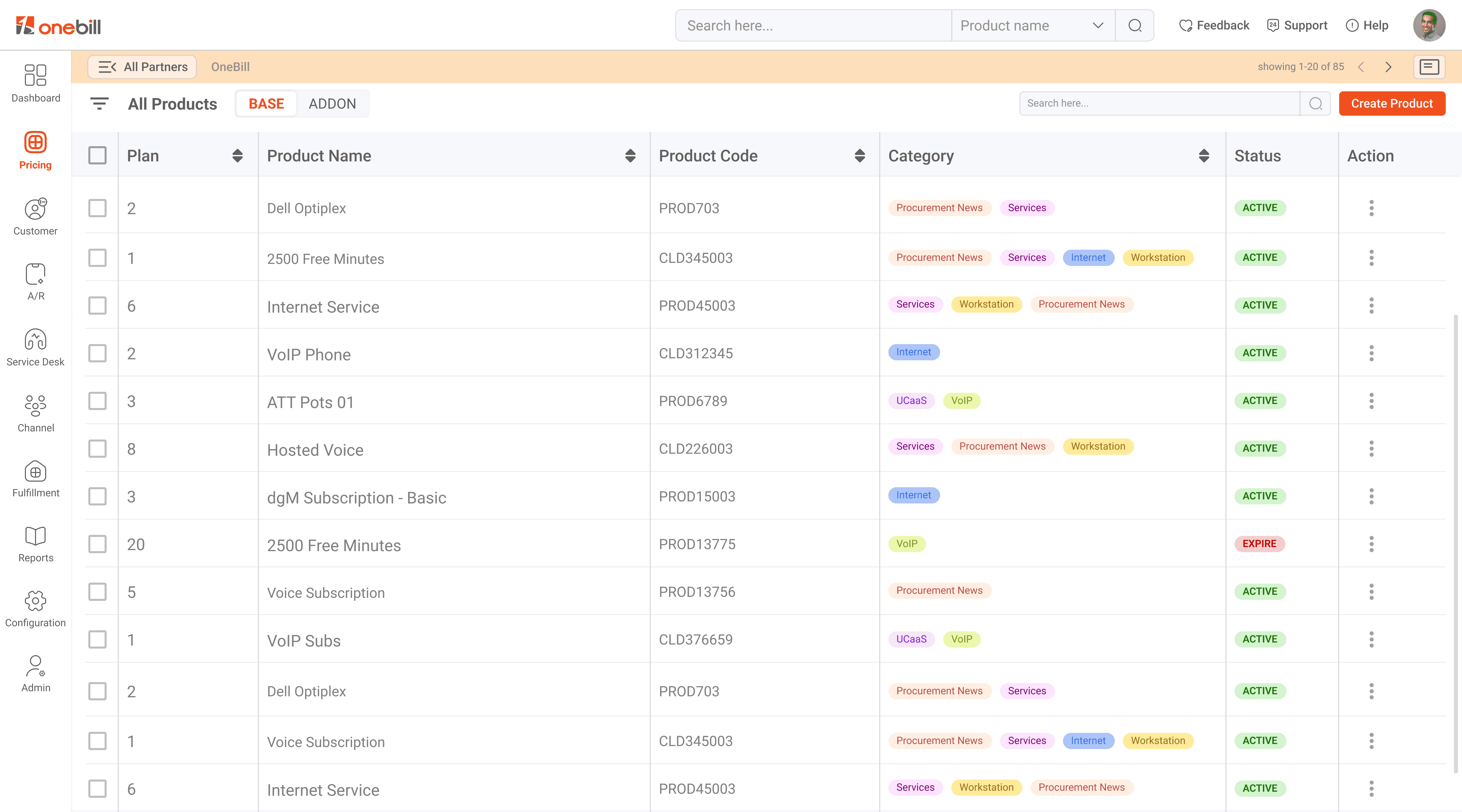
After - single canvas with categories visible at a glance
PRODUCT INFO
Streamlined plan editing
Streamlined the workflow for editing plans and products by surfacing related plans and their details in context. Added visibility for price plans and devices, enabling administrators to spot gaps and align offerings with requirements without ever leaving the view.
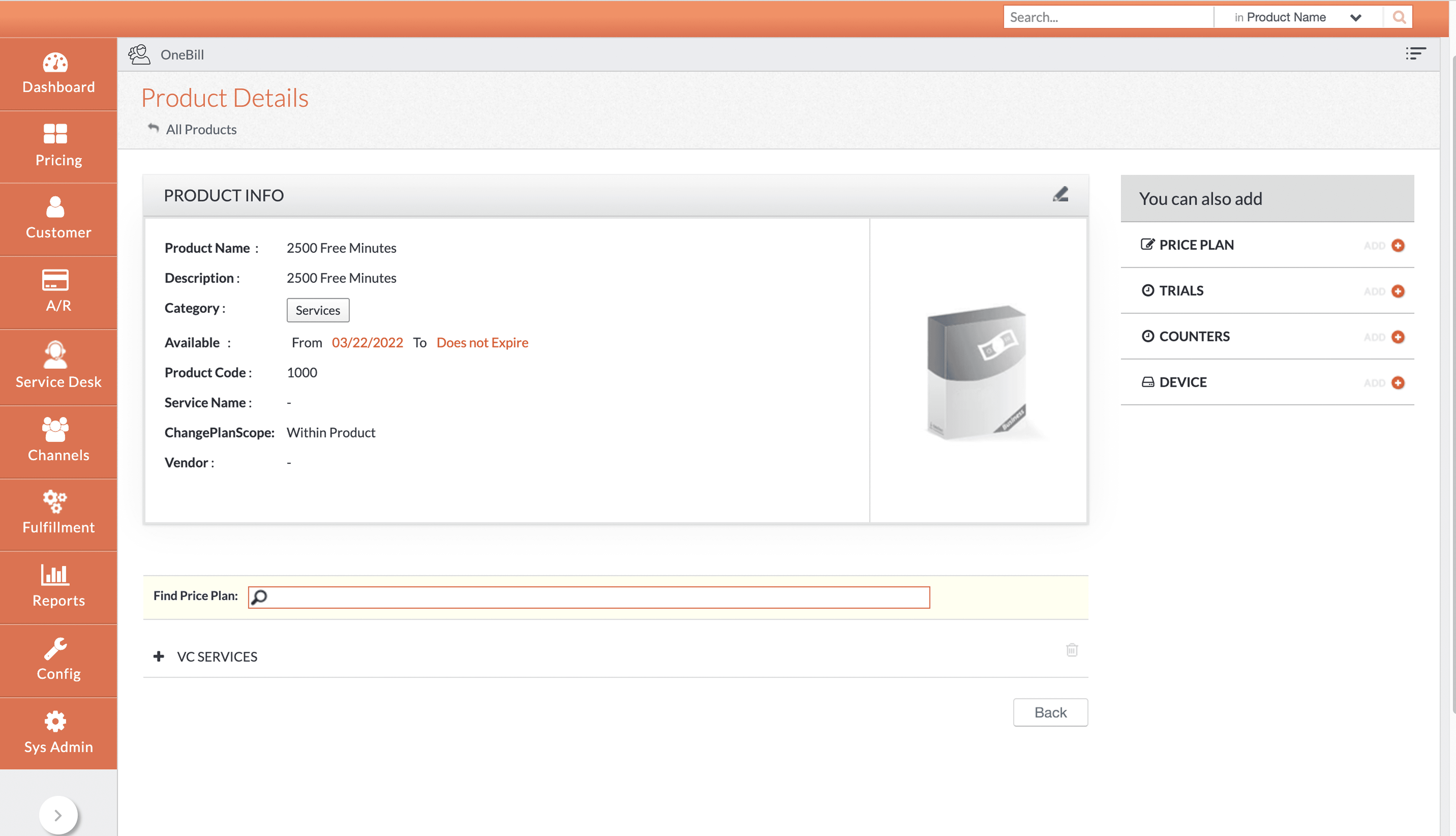
Before - related plans required separate page loads
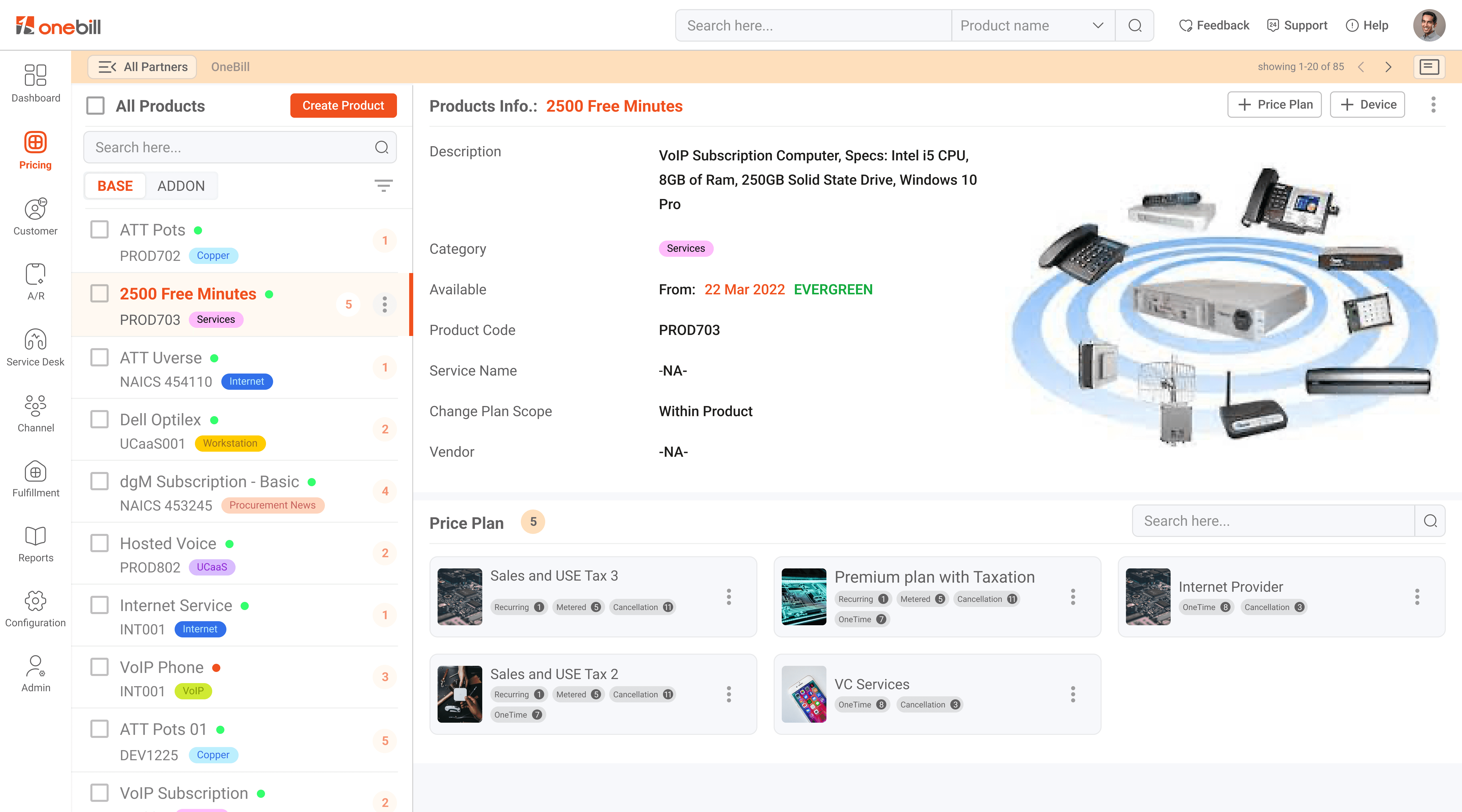
After - related plans and details surfaced in context
ADD PLANS
Pricing-first information architecture
Surfaced 'Add Plans' under Pricing instead of burying it in Configuration — a small relocation that made the platform significantly more accessible to new administrators. IA decisions like this compound: each one removes a moment of friction in a workflow that repeats daily.
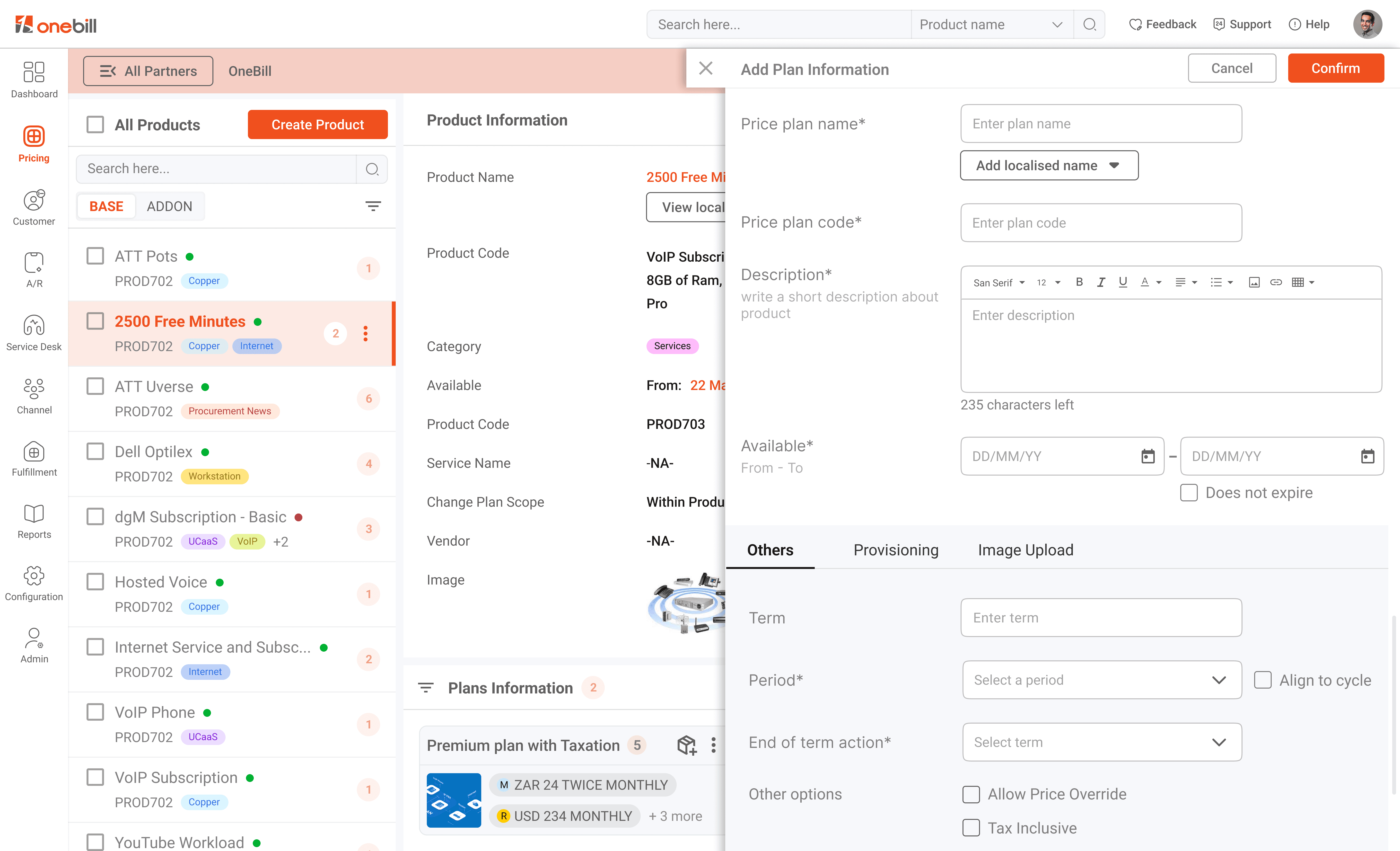
COMPARE & CONFIGURE
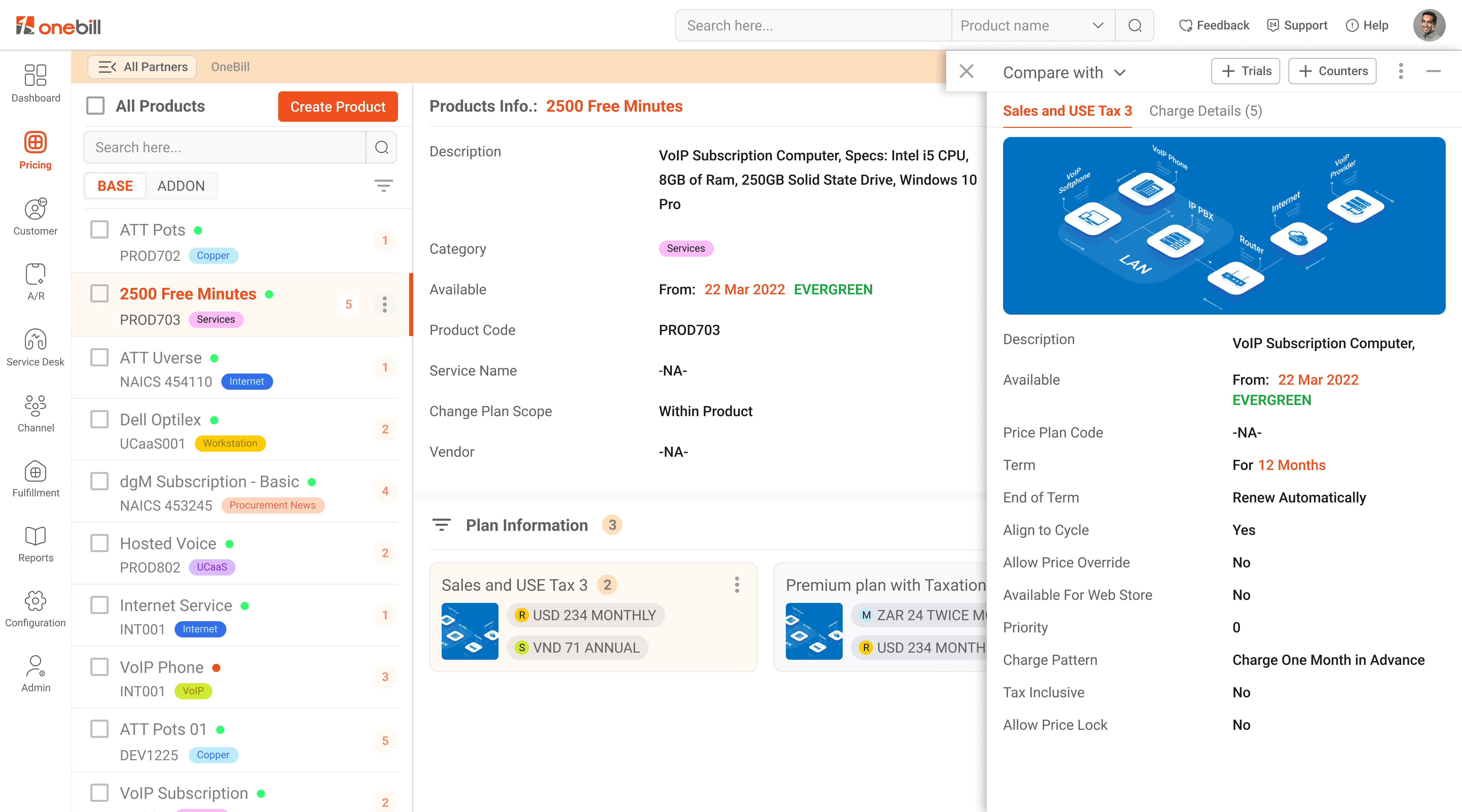
Side-by-side comparison, in place - New feature
New capabilities the old IA couldn't support: compare plans side-by-side, and configure trials and counters directly within the plan editor. Operations that previously required multiple pages now happen on the same canvas — the design bet, made tangible.
BEFORE VS AFTER
What changed, structurally.
BEFORE
Fragmented multi-page navigation to complete single tasks
No in-context plan comparison or device management
Flat architecture with poor scalability as catalog grows
Flat architecture with poor scalability as catalog grows
AFTER
Consolidated single-view with tabbed interface pattern
Modular IA designed for unlimited product catalog growth
In-context plan comparison, device & trial management
42% faster task completion with zero page navigations
MEASURABLE RESULTS
What I can honestly claim.
Shipped into the OneBill platform. Here's the line between what's directly attributable to the design and what was reported by the client after rollout.
42%
Reduction in time to create & compare plans
Client-reported, post-rollout
0
Page navigations needed for plan & device management
Verifiable from the design
10+
Modules unified under scalable IA
Pricing module scope
In-Context Editing
Plans, devices, trials, and counters managed without leaving the product view — the design bet made tangible.
Scalable Architecture
Modular IA accommodating growth in products, pricing tiers, and tax configurations without spawning new silos.
Plan Comparison
Side-by-side comparison of pricing, terms, and configurations in a single view — previously impossible.
Consolidated Views
Tabbed interface for Information, Plans, Devices — zero multi-page overhead in administrator workflows.
GROUNDING THE DECISION
What this project confirmed about how I design.
01
Name the constraint, don't hide it
A 2-month timeline shaped every decision. Calling it out — rather than pretending the project had unlimited room — turned a perceived weakness into a defensible strategic choice.
02
A design bet beats a vague goal
"Maximum operations on a single page" is a specific, testable principle. "Improve the UX" isn't. Picking a concrete bet — and holding the line on it — made the IA decisions almost write themselves.
03
IA should map the job, not the org chart
The old structure mirrored OneBill's internal systems. The fix was to reorganise around how administrators actually compose an offer. Structure that follows the workflow needs no mental translation.
04
Design for the next feature, not just this one
An IA that can't absorb growth is a liability. Building the hierarchy to extend — rather than fragment — when new pricing models arrive was the difference between a patch and a foundation.
05
Attribute every number to its source
The 42% was the client's report after rollout, not my controlled measurement. Separating what I can prove from the design from what was reported to me is what keeps the rest of the case study credible.
06
Right-size the research to the time
No user interviews or usability testing was the honest reality of a 2-month enterprise project. Platform audit, business requirements, and competitive benchmarking were the methods that fit — and being precise about what was done builds trust.
Good enterprise IA is invisible. It's the difference between a platform that grows and one that just gets more crowded.
The OneBill work taught me that the hardest IA problems aren't about adding structure — they're about removing the structure that no longer serves the person using it. When an interface is organised around the systems that built it, every new feature makes it worse. When it's organised around the job, every new feature makes it better.
A 2-month brief forced a specific kind of clarity: pick the right bet, defend it, and ship. Enterprise design is full of moments where you have to choose between doing more research or making a sharper decision — and the honest path is naming which one the timeline allows.
Let's build something great together
Designed & built with care · Edwin Fernandes © 2026
Available for full-time roles